Five examples, five useful ideas.
Follow each exact result, then try the same pattern with your own numbers.

01Add unlike denominators
Thirds and quarters describe different-sized pieces. Rename them as twelfths, the least common denominator. Then 8/12 plus 3/12 makes 11/12.

02Subtract equal-sized pieces
Rename one half as two quarters. Removing two quarters from three quarters leaves one quarter. The denominator describes the piece size and stays four.

03Combine a negative and a positive
The negative half cancels two of the three positive quarters. One positive quarter remains. This is addition of signed quantities, not subtraction of the denominators.

04Add three fractions
Three pieces of size one third make one whole. The result is an integer, so there is no need to display a zero fractional part.

05Include whole-number parts
Treat each mixed number as one quantity. Three halves plus nine quarters becomes six quarters plus nine quarters: fifteen quarters, or three and three quarters.
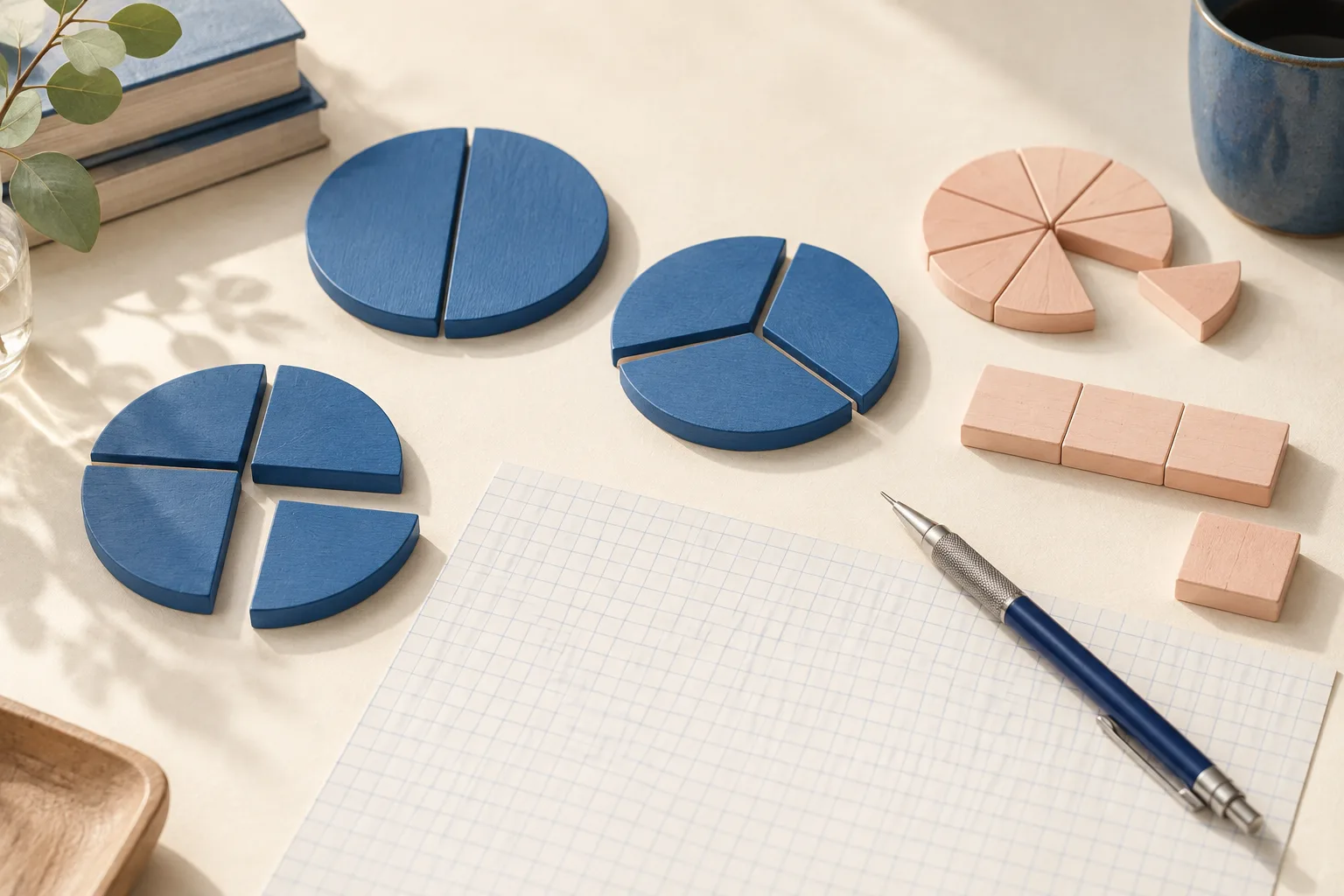
A fraction calculator that shows the reasoning
A fraction is a ratio of two integers. The numerator tells you how many equal parts you have; the denominator tells you how many of those parts make one whole. In 3/4, three of four equally sized parts are selected. The size of the whole must stay consistent when you compare, add, or subtract quantities. Three quarters of a small sheet is not automatically the same area as three quarters of a large sheet.
Use this fraction calculator to check a calculation after choosing the operation your question requires. The result panel separates the exact answer from its decimal representation. A fraction such as 1/3 is exact even though its decimal expansion continues forever. Parentheses identify the repeating block, while an ellipsis identifies a display that has been cut short. Those two markings mean different things.
Enter fractions, whole numbers, and mixed numbers
Write a fraction with a slash, such as 7/8. For a mixed number, leave a space between the whole part and the fraction: 2 3/5 means two plus three fifths. Write a whole number on its own. The fraction calculator also accepts decimal inputs, which it converts to an exact rational value before calculating. A decimal point is required; commas are not decimal separators here.
Put a negative sign at the front of a mixed number to make the entire quantity negative. For example, -2 1/3 means -(2 + 1/3), or -7/3. It does not mean -2 + 1/3. Use one number in each field rather than typing an entire expression into a field. This makes the selected operation and the order of your numbers visible.
Choose the operation before checking the answer
For addition and subtraction, both fractions need a common denominator. The fraction calculator finds the least common denominator, rewrites the numerators at that scale, and combines them. It never adds or subtracts the denominators themselves. With 2/3 + 1/4, the common denominator is twelve, so the numerator calculation is eight plus three.
For multiplication, multiply numerators together and denominators together. Common factors can be cancelled before that multiplication. For division, multiply the first fraction by the reciprocal of the second. Only the divisor is inverted. A common denominator is unnecessary for either multiplication or division, although the resulting fraction still needs to be simplified.
Understand all three answer forms
The reduced fraction is the main exact result. A greatest common divisor removes any factor shared by its numerator and denominator. A mixed number is another exact way to write an answer whose magnitude is greater than one. The decimal is useful for comparison or measurement, but a long decimal preview should not replace the exact fraction in later calculations.
The fraction calculator uses integer arithmetic to keep rational values exact. It can therefore handle inputs beyond the reliable integer range of ordinary floating-point arithmetic. Inputs are limited to eighty characters each to keep the tool responsive. Decimal expansion stops after sixty digits if no repeating cycle has yet been identified; the exact fraction remains available even in that case.
Check a fraction calculation independently
Before looking at the detailed working, estimate the answer. Adding two positive fractions gives a value greater than either input. Subtracting a positive amount makes the first value smaller. Multiplying by a positive number less than one reduces a positive starting value; dividing by that same number increases it. These checks often catch a wrong operation before you inspect any numerator.
You can also use an inverse operation. If a + b = c, then c - b should recover a. If a ÷ b = c and b is not zero, multiplying c by b should recover a. Keep the fraction form for that check instead of copying a truncated decimal. The fraction calculator shows enough intermediate steps to compare with your own written method.
Move to the tool that matches your next question
A general fractions calculator is useful when you already know the operation. A focused page is better when you need help with a particular representation or method. The mixed fraction calculator explains numbers with both whole and fractional parts. The conversion tools show why a quotient and a remainder become a mixed number, or why multiplying a whole part by a denominator produces an improper fraction.
For homework, first attempt one line yourself and then compare that line with the displayed working. For a recipe or measurement, attach the original unit to the final value and check that the inputs use matching units. This fraction calculator operates on numbers; it does not automatically convert cups to millilitres, inches to centimetres, or one measurement system to another.
Common questions
Can I use this fraction calculator with three numbers?
Yes. Choose Add a third number, enter the extra value, and keep the selected operation. All three entries use that same operation and are evaluated from left to right. For a calculation that mixes different operations or contains brackets, calculate the required sub-expression separately; this interface is not an arbitrary expression parser.
Why does the fraction calculator reject a denominator of zero?
A fraction means division by its denominator, and division by zero has no defined numerical result. A zero numerator is allowed when the denominator is nonzero: 0/7 equals zero. A zero-valued divisor is also rejected, even if its denominator itself is valid.
Does the answer always need a mixed number?
No. A proper fraction has magnitude below one and can stay a fraction. An integer answer needs no fractional part. Mixed form is an optional presentation of the same value, not a more accurate result. Use the form requested in your exercise.
What does 0.(3) mean?
The digits inside parentheses repeat forever. The value 0.(3) is exactly one third, while the finite decimal 0.333 is exactly 333/1000. You can enter repeating decimals using this parenthesis notation. An ellipsis in an output instead means that the preview was truncated.